Sunday, March 19, 2017

UDI U-841-1

Quadcopter No. 16 is second one by UDI

     The UDI U-841-1 is the sixteenth micro quadcopter in my fleet.  It was purchased January 22, 2017, the day after I got the Zoopa Riot.  The U-841-1 came from Micro Center in Sharonville, Ohio, the fourth drone from there.  It cost $39.99.  It has made 11 flights so far, all indoors.

UDI U-841-1

     This drone has a unique feature that sets it apart from all the other quads in the fleet: wheels.  A set of four wheels, as shown in the photo above, can be attached to the quad allowing it to be driven like a car.  There is also a set of two large wheels that can be attached using a long axle that snaps onto the top of the drone running from side to side.  There is a ground mode on the controller which prevents the "car" from taking flight when the throttle is increased.  In normal flight mode the "car" will take off and fly like any other drone.  A set of prop guards is also provided for use during normal flight when the wheels are not used.
      I found the drone to be a good flier, similar to the UDI U-27.  In fact, the batteries and the controller are interchangeable.  However, I did not like either set of wheels.  It was hard to steer the vehicle in both cases, and after one run of each, I have not tried them again.
     The fact that the controllers for the U-27 and the U-841-1 are interchangeable came in very handy when I brought this quad home; the new controller for the U-841-1 did not work.  The power indicator light did not come on and the unit would not bind to the drone.  I tried the U-27 controller and it worked just fine for all the features.  So, I decided to keep the drone and try to fix the controller if I could, knowing that I had another controller that would work with it.
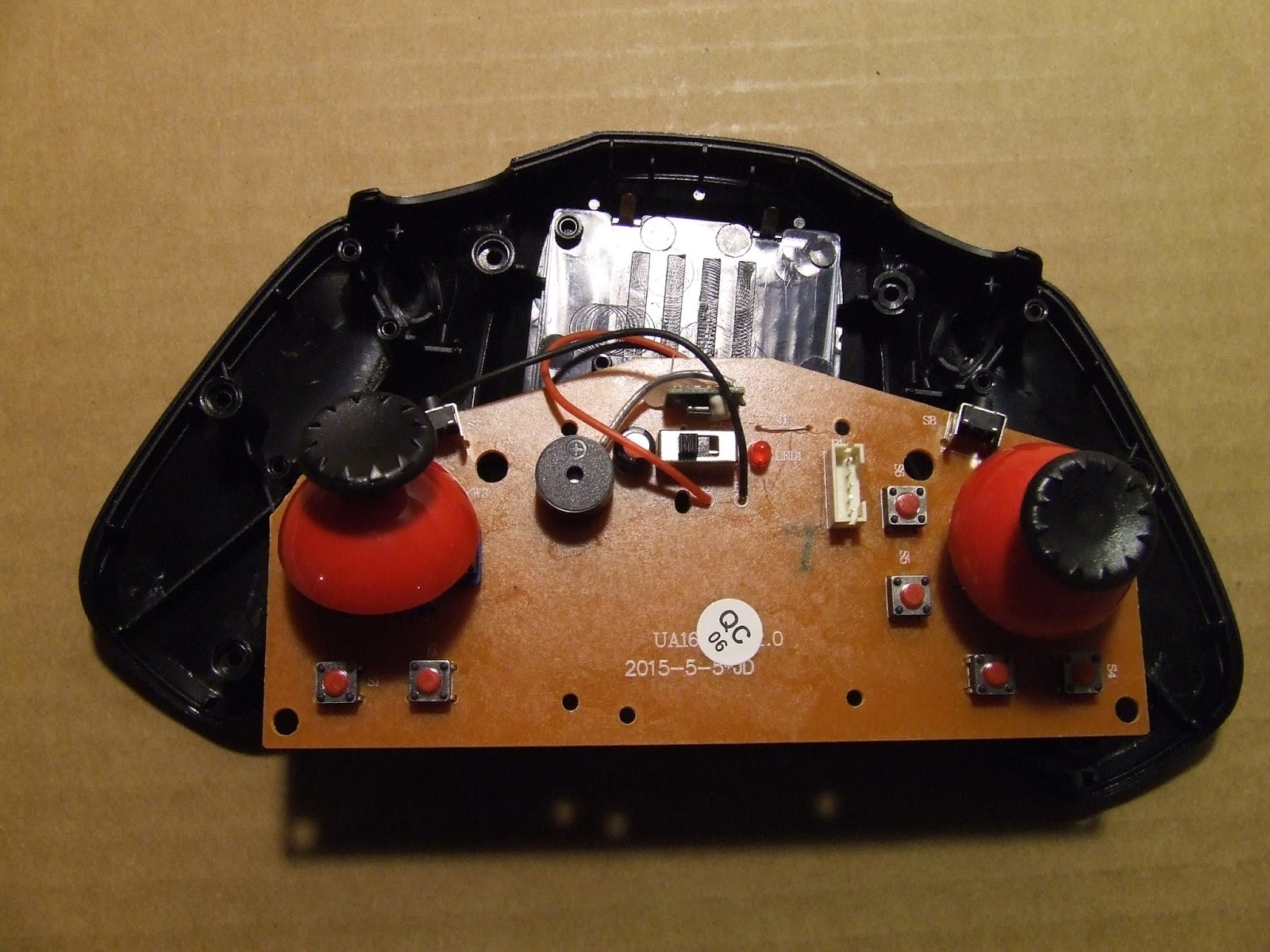
     I removed all of the necessary screws, opened the case, unplugged one connector, made a visual check for loose wires, and then, set to work with my Radio Shack multimeter.


Circuit board inside of U-841-1 controller


Control switches in U-841-1

     After a few minutes, I found that no current was getting out of the battery holder.  Then, I observed a small gap between two contact plates near where the power distribution wires attached.  I used a flat screw driver to slightly bend one plate so contact was made.  That solved the problem and the controller works fine.  I now have two interchangeable controllers.
     I wonder what others do when they get an inexpensive drone that doesn't work because of a small, correctable problem.  They could write one-star reviews on Amazon saying how their grandson's Christmas was ruined.  They could take it or mail it back to where it was purchased and ask for a replacement or refund.  But, how many would try to fix it?


Saturday, March 18, 2017

Zoopa Q165 Riot

No. 15 Joins the Fleet


     The latest drone to see action in the flight room is the Zoopa Q165 Riot from ACME the game company.  It was purchased on January 21, 2017, at Staples in Mason, Ohio, from the clearance shelf for $49.50.  The Zoopa Riot had been at $69.95 a few weeks earlier, which I thought was a bit too pricey.


Zoopa Q165 Riot

     ACME is a German company, located in Delbruck, Germany, but the Zoopa was still manufactured in China like all of my other drones.  I have flown it 11 times, all in the flight room.  It is a great quadcopter with very smooth handling.  It is one of a few that I can handle on high speed indoors.  This quadcopter has an interesting flip mode, triggered by a small orange button on the upper right side.  The instruction manual says to press and hold the flip button and then move the right stick up and release it immediately.  I have found that you only have to press the flip button and then you can release it and the next time you move the stick it will flip.  In fact, if you hold the flip button down and hold the stick forward the Zoopa Riot will do continuous flips until you release the button or stick!  This is one of a very few micro quadcopters that will do continuous flips.  I eagerly await warmer weather so I can try the continuous flips outdoors.
      The Zoopa seems to benefit from "German engineering".  It looks nice, handles great and seems to be fairly rugged.  Although, I have already cracked one of the prop guard rings and had to patch it with duct tape.


Friday, February 24, 2017

The Micro Quadcopter 500

500 Flights in 198 Days


     I keep a log of every flight that I make with my quadcopters, so I knew that on February 2, 2017, I had made my 500th flight.  I made my first flight with my first micro quadcopter, the Hubsan X4 H107L, on July 20, 2016.  Thus, it took me 198 days to achieve 500 flights; an average of 2.53 flights a day.  Of course, a lot of days, I didn't have a chance to fly any of my fleet, but, on the other hand, my one day record was 11 flights.  As a retired engineer, I enjoy keeping records and analyzing data.  I have put together the following table showing all of my drones, the number of flights for each, how many days since I purchased each one and the average number of days between flights for each drone.

Drone                          No. of Flights             Days since purchase       Days between flights

Spidex                                88                                  184                                  2.1
Hubsan                               64                                  198                                  3.1
Verso                                  52                                  196                                  3.8
Syma X13                          44                                  168                                  3.8
UDI-U27                            40                                  168                                  4.2
Spyder X                            36                                  158                                  4.4
Blade Nano                        30                                  191                                  6.4
Kodo                                  23                                  181                                  7.9
Sharper Image DX2             24                                  135                                  5.6
Proto Z                               22                                  170                                  7.7
Quadrone                            22                                 143                                   6.5
Sky Rover                          13                                   63                                   4.8
Sky Thunder                       12                                   63                                   5.3
Swift Stream                        9                                    44                                   4.9
UDI U-841-1                        6                                    12                                   2.0
Zoopa Riot                           6                                    13                                   2.2
Quadrone Spark                   5                                    12                                   2.4
Quadrone Sparrow               4                                    12                                   3.0


     The last four quadcopters have not been discussed in their own post, yet, since I am waiting to get more flights with each one to have a better understanding of their capabilities.  In the chart above, the "Days between flights" column gives a fairly accurate indication of which drones are my favorites.

Thursday, February 2, 2017

The Flight Room Becomes a Race Course

Results of a few time trials


     After flying all my drones back and forth the length of the flight room for a few months, I decided I needed more of a challenge: like a race course.  After some thought, I decided to use crepe paper streamers to make gates to fly around and through.  I took two eight-foot long pieces of paper, one blue and one orange, twisted them together and duct taped them to the ceiling and floor.  I put four of them in a row across the 12-foot width of the room, thus making three gates each four-foot wide.  I made three rows of gates, with rows being ten feet apart.  I now had a slalom course with nine gates that I could fly through using a variety of different patterns.

Slalom Course looking North

Slalom Course looking South
     I started out with the simplest course: a rectangle.  Fly down the three gates on the left side, across the back and up through the three gates on the right.  I wanted some quantitative measure of how well I could fly each of my quads on the course, so I decided to time each one in a three lap race around the course.  I would start the stop watch on my wristwatch, take off from the launch pad on the floor, fly the three laps, land (or crash) into a bean bag landing zone and stop the clock.
     I soon learned that flying this course was not easy!  Part of the problem was my lack of experience and skill and partly the narrow size of the gates for the speed and quickness of some of the drones.  A major problem was misjudging the speed of the quad and the distance to the back wall.  Luckily, the walls are padded.  I also chewed up plenty of streamers with the props.  Using the slowest speed settings for each drone, I have completed the course 41 times.  The best time was with my Syma D44: 37.06 seconds.  Here is a list of the number of times I finished the course (three laps) for each drone and the best time for each:

Quadcopter                   Completions      Best Time (seconds)

Syma D44                              3                    37.06
Ares Spidex                           4                    37.36
Sky Rover                              2                    38.44
Propel Spyder X                    5                    38.68
Swift Stream                          5                    39.89
Syma X13                              5                    44.45
Quadrone                               2                    46.63
Dromida Verso                       1                    52.89
Hubsan H107L                      6                     53.37
Dromida Kodo                       1                     54.37
Blade Nano                            1                     59.90
Sharper Image DX2               2                     63.32
UDI U-27                               2                     64.49
Estes Proto Z                          2                     67.32

     As can be seen from the results, there was quite a range of times over the entire fleet.  I was able to get each one of my quads through the course at least once, but is was a challenge for a few.  The best times, I feel, represent the quads that are the easiest for me to control and not necessarily the fastest ones.  My Blade Nano is certainly the fastest drone in the fleet, but I just couldn't control it well enough on this tight course to get a good time.  The Propel Spyder X set the record by having  completed the course all of its five times on the same battery charge.
     After a few days, I scrapped the slalom course, afraid I was going to do some major damage to a few of my drones.  I then built a simple oval race course with a large pylon at each end of the flight room.  Each pylon consisted of four two-stranded, twisted streamers attached to a paper plate at each end and tacked to the ceiling and taped to the floor.     


Two Pylon Race Course

Close-up View of  a Pylon

     Again, I timed three laps around the course for each quad.  The times dropped significantly for this new arrangement.  With a total of 90 course completions the results were:

Quad                               Completions      Best Time (seconds)

Quadrone Sparrow                  6                        25.81
Zoopa Riot                              5                        26.09
Propel Spyder X                     17                       27.07
Dromida Verso                         7                       27.53
Blade Nano                              6                       27.70
Dromida Kodo                         6                       28.48
Hubsan H107L                         6                      28.98
Swift Stream                            6                       29.21
Syma D44                                7                       29.27
Ares Spidex                            15                       30.24
Sky Rover                                3                        32.20
UDI U-841-1                            1                       35.95
Quadrone                                  2                       36.54
Syma X-13                                1                      37.87
Sharper Image DX-2                 1                      38.03
UDI U-27                                  1                      41.44

     You will notice that a few new names appear on this course due to some new purchases.  I could not get the Proto Z or the Quadrone Spark around the course to the finish, although, I tried.  As before, I am sure that the times reflect my flying ability more than they do the quads' speeds.  This course was much easier than the previous one and I enjoyed it a lot more.

Wednesday, January 25, 2017

Sharper Image DX-2 goes to the Repair Shop

A little solder fixes the problem


     While flying my Sharper Image DX-2, it crashed into a pylon on the race course in the flight room.  I will talk about the race course in an up-coming post.  Usually, hitting a pylon is not dangerous since they are made of crepe paper streamers.  Whenever I hit one, I immediately shut down the throttle to avoid having the props cut the paper or getting the paper wound tightly around the prop and its shaft.  Most often the quad gets tangled in the streamers and stays suspended until I retrieve it, or, it falls harmlessly to the carpet.  

The race course pylons


     This time the DX-2 fell to the floor.  When I put it back on the launch pad everything appeared fine.  But, when I increased the throttle it immediately rolled over, not once, but a couple of times.  I inspected the propellers while slowly increasing throttle and discovered that one motor was not turning.  So, after removing 12 tiny screws, popping off the props and prop guards and separating the upper and lower sections of the quad, the problem was immediately apparent: a motor wire had a broken solder connection.  The only previous time that I had damage to a motor was with the Blade Nano when the motor cap pulled off and I had to replace the whole motor; but it just plugged in.


The DX-2 disassembled


     I got my soldering tools out and in a matter of minutes had the wire reattached.  I plugged the battery in, turned on the quad and the controller and carefully gave it a little throttle.  The motor spun perfectly.  But, another one of the motors would not spin.  I soon found that I had accidentally broken another connection.  A bit more soldering and that one was also fixed.  Reassembly and then back to the flight room to finish the flight and try to avoid the pylons.
     While I had the quad apart, I discovered that the battery could easily be replaced by soldering if and when the battery ever died. 

Saturday, January 14, 2017

Swift Stream Z-32CV Camera Drone

Drone #14: Swift Stream Z-32CV


     My fourteenth micro quadcopter is the Swift Stream Z-32CV.  It was purchased at CVS / pharmacy in Maineville, Ohio, on December 21, 2016, for $29.99.  The Swift Stream is larger than any other of my drones.  At 120 mm diagonally from propeller center to center, it is over my intended limit of 115 mm, but, at this price and with a camera, I could not pass it up.  My next largest drone is the Dromida Verso at 112 mm.

Swift Stream Z-32CV Camera Drone


     I have made six flights with the Z-32CV in the flight room.  It handles very nicely and I cannot wait to get it outdoors and see what it can really do.  The quad has very long landing gears which give me some problems.  If it just grazes the carpeting while flying horizontally, the landing gears will catch and flip the drone over.  And, when landing, it has to come straight down with no horizontal component to avoid flipping.  Except for this, it is great fun to fly.
     With this post, I have completed introducing my entire fleet of fourteen micro quadcopter drones.  I think it is quite a diverse group with plenty of variations and different options.  But, it is time for me to think about expanding the fleet for there are plenty of quads on the market with all new features just waiting for me to try.  So, I am asking my reader(s?) to suggest new drones, similar to the ones I now have, that I might invest in.  My only requirements are:

     1. They have to be QUADcopters - four propellers only.
     2. They use 1S LiPo batteries.
     3. They measure approximately 100 mm (4 inches) diagonally across the propellers center to center (85 - 115 mm, 3.5 to 4.5").
     4. They cost less than about $50.  More, if they have some great new unique feature.
     5. No FPV, yet.

     So far, all of my drone purchases have been from local merchants, but I am running out of sources for new ones that meet my criteria and will have to eventually go online for additions to the fleet.  Amazon, here I come.

Thursday, January 12, 2017

Syma Sky Thunder D44 Dragonfly Drone

Lucky No. 13 of the Fleet


The Syma Sky Thunder D44 Dragonfly Drone has the longest name of any of my drones.  I acquired it on December 2, 2016, from Meijer in Loveland, Ohio, for $39.99.  I have flown it nine times, all in the flight room.

Syma Sky Thunder D44 Dragonfly


     The D44 is a fun micro quadcopter, although, it does not have any unique features that my other drones don't already have.  It combines easy control with fairly fast flight.  When I set up a slalom course in the flight room and flew each drone around it, the Sky Thunder had the fastest time of all.  Again, that does not mean it is the fastest drone I have, but rather the one that I personally can control best at high speeds.  And, its margin of victory was very slim.  I will give a more detailed description of the race course and flight results for each quadcopter in a future post.
     Like my other Syma drone, the X13, the D44 has geared props.  In addition, the motors on the Dragonfly are horizontal with the motor shafts perpendicular to the propeller shafts.

Wednesday, January 11, 2017

Sky Rover Voice Command Drone

The Twelfth Drone in the Fleet


     The twelfth micro quadcopter in the fleet, the Sky Rover Voice Command Drone, was purchased on December 2, 2016, from Barnes & Noble in Cincinnati, Ohio, for $60.86.  I have flown it ten times, all in the flight room.

Sky Rover Voice Command Drone


     The obvious difference between this drone and all of my other ones is the voice command option.  The first time I tried the voice command feature was a disaster.  The drone only recognized a small number of my commands; not understanding or incorrectly interpreting most of them.  That is when Cheryl, my wife, decided to give it a try.  Amazingly, she had instant success with the commands, getting almost everyone right.  Since she was a mathematics professor and also trained in acting and opera, she explained to me that I had to speak more clearly and distinctly.  Sure enough, I can now get it to do almost everything I want it to.  Of course, I still have the control sticks to correct any problems that arise.  We like the fact that the Sky Rover is the only quadcopter that we can fly together at the same time.  Cheryl uses the voice command microphone and I use the sticks on the transmitter.  Since the microphone plugs into the transmitter we have to stand close to each other, but it works just fine.  Whenever she has a problem getting a voice command to act quickly enough to get her out of trouble, I just use the sticks to help her out.

Sunday, January 8, 2017

Sharper Image DX-2 Stunt Drone

My Eleventh Micro Quadcopter

     On September 21, 2016, I purchased the Sharper Image DX-2 Stunt Drone from Walmart in Mason, Ohio for $33.88.  I have flown it 20 times in the flight room.

The Sharper Image DX-2 Stunt Drone


     This quadcopter has several new features differing from the rest of my fleet.  By pressing and holding the flip button and then moving the directional stick in any direction, the drone will flip up to three times in a row.  Pressing the Auto Landing button makes the drone automatically descend until it lands.  I have used both of these features successfully in the flight room, but I am sure they will work much better when I get a chance to take the quad outside.  With less than eight feet from floor to ceiling, neither function is great.

Quadrone

Micro Quadcopter No. 10


      My tenth quadcopter was the Quadrone from Suncoast Motion Picture Company in Cincinnati, Ohio.  I bought it on September 13, 2016 for $39.99.  I have flown it 17 times, all in the flight room.

Quadrone

 
         The Quadrone comes with propeller cages that make it especially suited for flight indoors.  Crashes don't seem to have much of an effect on it, although I did crack one cage and had to repair it with tape.
     The 300 mAh LiPo battery that came with the quad was swollen as soon as I opened the box.  I kept a close watch on it while recharging and after flights.  The swelling went away after a few cycles, but the battery failed to hold a charge after only 11 flights.  I was lucky to find the same size battery at Hobbytown, that was made by Ares, and worked just fine in Quadrone.
     The drone has three speeds.  It is one of the few that I can fly in the flight room at medium speed and still adequately control it.  At slow speed its response to changes in direction is weak.  All in all, it is a fun quadcopter to fly.
     When I inquired about the Quadrone at Suncoast, the clerk told me that he had never sold one before, didn't know anything about them and could not understand why the store manager even had them on display.  I am glad I ignored his negative attitude and purchased one anyway.

Saturday, January 7, 2017

Propel Spyder X

Micro Quadcopter Drone Number Nine

     The Propel Spyder X was my ninth quadcopter.  I bought it on August 26, 2016, at Office Depot in Cincinnati, Ohio, for $49.99.  I have flown it 27 times, mostly in the flight room.  It combines speed with great handling and is fun to fly.

Propel Spyder X


     The Spyder X has a unique LiPo battery system.  The battery is enclosed in a plastic case that slides into the drone, locks into place and turns the quadcopter on.  At the end of the flight, you push a button to release the battery and slide it out.  You then use a special charging cord to recharge the battery.  I cannot use my multi-charger with this battery and therefore cannot check the voltage or the charge.  The battery case hides the printing on the battery, so I cannot see what size battery is being used.  The case comes apart by removing three very small screws, but I am waiting until the battery fails before opening it up.  It appears that you should be able to replace the battery.
     I joined the Propel Flight Club.  It is free and you can earn points that allow you to get discounts on their products and free replacement parts.  I haven't needed any of those, yet.

Friday, January 6, 2017

Syma X13 Storm

Micro Quadcopter No. 8


     The Syma X13 Storm was my eighth quadcopter purchase.  It was bought at Micro Center in Sharonville, Ohio, on August 19, 2016 for $29.99.  I consider it to be one of the best values that I have had in buying micro quadcopters.  This drone was obtained at the same time and place as my UdiRC U27 Free Loop.

Syma X13 Storm

     This quadcopter is definitely one of my favorites.  I have flown it 38 times, both indoors and out.  It came with a 200 mAh LiPo battery, and I have found that I can also use the Ares Spidex 180 mAh batteries as well, since I have four of them.  It has very smooth and quiet operation, especially at low speed, making it ideal for the flight room.  In fact, it is the only drone I have that my wife, Cheryl, enjoys flying indoors.  A unique feature of the drone is the gears connecting the motors to the propellers.  Each motor shaft has a small gear and the prop shaft a larger one.  This allows the quad to have larger, slower moving props, than if the props were on the motor shafts.  I assume this contributes to the smooth and quiet operation.
     The Syma X13 has a battery compartment with a hinged door on the underside.  After plugging in the battery, you place it in the compartment and snap the door shut.  The drone is turned on with a small switch.  After several flights the hinge fell out of the door.  I used part of a paper clip to replace it.  With a little duct tape, that worked well.  I finally found the hinge in the flight room carpeting and reinstalled it along with the duct tape.  I also put tape on the door latch, since that was coming open during flight whenever I touched the floor.

Tuesday, January 3, 2017

UDIRC U27 Free Loop

Drone #7 UdiRC U27

     The UdiRC U27 was my seventh drone, bought from Micro Center in Sharonville, Ohio, on August 19, 2016, for $34.95.  I have made 35 flights, both indoor and out.  In the flight room, I use low speed and still have to be very careful of what I do since the U27 is fast and sensitive.  It has three speed settings and starts up in medium speed.  I invariably forget this fact, for about five seconds of flight, then I remember, and quickly switch to low.  The U27 is quite heavy for its size and uses the largest battery, 450 mAh, of any drone in my fleet.

UdiRC Free Loop
     I have crashed it several times, but the only damage was having a prop guard pop off, and that was quickly fixed.
     The instruction manual for the U27 is written in somewhat broken English and could use quite a bit of editing.  I actually had no trouble understanding what was being explained, and often had a chuckle at how it was said!  Remarkably, I have seen full page ads by UdiRC in top drone magazines and they use the same poor English.  You would think the editors of national magazines would suggest some improvements in grammar.

Friday, December 30, 2016

Estes Proto-Z

My Sixth Micro Quadcopter Drone

     I bought my sixth micro quadcopter, the Estes Proto-Z, on August 17, 2016, from Entertrainment Junction in West Chester, Ohio, for $29.99.  I was very familiar with Estes, having flown model rockets in the late 1960's when Estes was a leading supplier to the hobby.  I have flown the drone 19 times and found it to be one of the simplest ones I have to fly.  That might be because it has very few options to learn.  It has only one speed and no trim buttons, but you can recalibrate the sensors.  With no prop guards, crashes are to be avoided.  There is a right flip button, a left flip button and a headless mode option, and that is it.  The LiPo battery is not intended to be removalable, so replacing it will require taking the drone apart to see if it can even be replaced.  A special charging connection means I cannot use my multi-port charger to recharge it, but have to use the USB charger that comes with it.

Estes Proto-Z

     After a recent crash, the drone developed a severe roll to the left.  So severe, that I could no longer control the quad.  Since there are no trim functions and recalibration did not fix the problem, I thought I would have to scrap my Proto-Z.  Then, I read in my Hubsan X4 H107L operating manual that you could overcome a severe drift by shimming the unit upon startup.  I tried this by slipping a Lego brick under the right side of the Proto-Z while linking and arming, and it took care of the problem well enough so I could fly it again!
     I have notice that when the Proto-Z slightly touches a wall or the carpet it will yaw a small amount in either direction, and then in a second or two it will self correct this yaw and fly straight.  None of my other drones will do this.  If the contact is more than "slight", it will not self correct!

Thursday, December 29, 2016

Dromida Kodo HD

Drone No. 5

     The fifth drone added to the fleet was the Dromida Kodo HD.  What obviously sets the Kodo apart from all of my previous drones is its camera.  I had been putting off buying a camera drone because there was so much to learn about simply flying drones that I did not need the extra complications of using a camera.  But, curiosity got the better of me, and I decided to give it a try.

Dromida Kodo HD


     I bought the Kodo at Pit Row Hobby Shop in Cincinnati, on August 6, 2016, for $59.99.  That is the second highest I have paid for a drone.  I believe it was good value, since the Kodo is a great, quick flier, like its cousin the Dromida Verso, and it has the camera.  I have flown the Kodo 19 times so far; a few times in the flight room to learn the controls and check everything out, before going outside to try out the camera.  My first flight in the basemen, I had a small problem.  To start recording video, you press a button and then press the same button to stop recording.  I lost track of where I was in regards to recording; when I thought I was stopping the video, I was actually starting it and vice versa.  There are no lights on the transmitter to tell you if you are recording.  So, instead of having flight video, I had video of my shoes walking up to the quadcopter to turn it right side up after all the crashes!  I found that the key was to turn the video on and then don't crash.
     Once I got outside, I visited a nearby park with a large field surrounded by trees.  I got the Kodo up to about the same height as the trees and was ready to start the video.  Since the transmitter is fairly small, I had to glance down to find the video button.  When I looked back up, I could not find the Kodo.  This would have been a disaster, except that my wife, Cheryl, was with me and had kept sight of the drone.  From years of birding together, she was able to quickly direct my sight back to the bird - I mean drone, just before it was about to enter the woods.
     I think the Kodo takes decent quality photos and videos for such an inexpensive drone.  I just have to improve my flying abilities - a lot - before I can get good results.

Sunday, December 25, 2016

Ares Spidex

My Fourth Micro Quadcopter Drone


     I bought the Ares Spidex on August 3, 2016, at Hobbytown in Cincinnati, Ohio for $34.99.  It has become one of my favorites with 69 flights, the most of any of my micro quadcopter fleet.  I bought three extra batteries at Hobbytown at $7.99 each, so when I take it out to a nearby park, I can have multiple flights.  Except for propellers, I have never had any damage to the drone from crashes.  With three speed settings, it is fun in the flight room and outdoors, even with a slight breeze.

Ares Spidex

     I have done more experimenting with the Spidex in the flight room than with any other drone.  Its light weight and quick response make it ideal for various projects.  I have attached a thin string to the ceiling and have run it to the floor where I tied it to the body of Spidex.  Then, using only pitch and throttle the drone can become a pendulum.  I quickly learned to adjust the throttle to give the largest arc to the pendulum, while never letting the drone hover, for then the string would wrap around the propeller shaft - not good!  I then arranged plastic cups in a circle on the floor.  By adding roll to the pitch, micro quadcopter pendulum bowling was possible.
     Another time, I attached a two-inch piece of plastic tubing to the body of the Spidex with two rubber bands.  I then ran string from one end of the flight room, through the plastic tube and to the other end of the room.  Now I had a Spidex zipline.  Using pitch and throttle, I could zip the drone from one end of the basement to the other, and not worry about crashes.  Or, using roll and throttle, I made Spidex swing from side to side like a long jump rope.  Finally, the 360 degree flip button worked great, and again, never any crashes.
     My grandchildren and I are big Lego builders.  Before getting into drones, that was the main use of the basement.  We have around 50,000 pieces of Lego, with plenty of wheels and axles.  So, I have just started experimenting with attaching wheels to Spidex.  The added weight prevents the drone from lifting off, but it does roll around on the carpet from one end of the room to the other, like a remote controlled car.
     Anyone can see why Spidex is one of my favorite quadcopters.  Winters in Ohio can be long and nasty, so having a flight room and a good supply of drones can be great fun.

Blade Nano QX 3D

Micro Quadcopter #3

     The Blade Nano QX 3D was the third micro quadcopter drone that I purchased, on July 27, 2016, from Hobby Express in Loveland, Ohio.  At $79.99, it is the most expensive drone I have purchased.  Is it worth the extra cost?  Maybe.  I have only flown the QX 3D 25 times; far less than my Hubsan X4 H107L, my Dromida Verso and several other micro quadcopters that were purchased more recently.  One reason for the fewer flights is the amazing speed that the QX 3D has.  Even on the slowest speed and lowest sensitivity, I can get into trouble in the flight room.  Outdoors, it is great fun, flying inverted as well as right side up.  I am simply waiting for better weather before flying it a lot more.  The QX 3D is fast and nimble because it is very light weight.  The motors are mounted on extensions of the main circuit board.  The motors sit in plastic cups that have two clips attaching them to the frame.  These cups also have two clips holding the motors in.  On hard crashes, the plastic cups can pop out of the frame and the motors can pop out of the plastic cups.  On the fourth flight of my Blade Nano, after crashing, a motor popped out and pulled the end cap off, ruining the motor.  A nice feature about the drone is that the motors simply plug into sockets mounted next to the plastic cups.  So, after buying a package of two new motors from Hobby Express for only $17.99, I simply plugged in a new motor and was ready to fly - only more cautiously than before.

Blade Nano QX 3D


Saturday, December 24, 2016

The Dromida Verso

My second micro quadcopter


     I purchased my Dromida Verso two days after getting the Hubsan X4 H107L.  I bought the Verso from The Hobby Shop in Dayton, Ohio for $37.99 on July 22, 2016.  I have flown it 43 times, both indoors and outdoors.  It has three speed setting: 20%, 60% and 100%.  Even at low and medium speeds it is quite fast and great for the flight room.  Maximum speed, for me, is restricted for outdoors, where the Verso can streak from one end of my flight field to the other in seconds.  Because of its quickness, and my lack of flying experience, my Verso has crashed numerous times and has received damage to the frame.  The rings that hold the motors onto the frame arms have cracked on two of the arms allowing the motors to fall out on the slightest crash or even normal landings.  I put a narrow strip of duct tape around the rings covering the cracks.  This has taken care of the problem - so far.

Dromida Verso


      One of the nice features of the Verso is the ability to do both 180 deg. and 360 deg. flips.  Holding the flip button in for two seconds switches from one type of flip to the other.  After doing a 180 deg. flip, the quadcopter is obviously flying upside down.  You can even take off in the upside down position.  When flying inverted each motor has to turn in the opposite direction than when flying upright.  This has me somewhat confused.  The instruction manual's parts list shows a CW motor and a CCW motor.  And, two of the motors on the Verso have black and white wires and two have red and blue ones indicating two different types of motor.  But, if all the motors have to change direction after a 180 flip, there is no need for CW and CCW motors: one design will work for all four motors.  Maybe the Verso is based on some previous design that did not have reversing motors.
     The LEDs on the Verso can be turned off with the press of a button.  I am not sure how much longer flights are with the lights off, but I turn them off when I am outdoors in the daytime.  I can just barely see the quad sometimes, let alone the LEDs.

Friday, December 16, 2016

Pitch, Roll and Yaw

Micro Quadcopter Nomenclature

     In my fleet of drones, I have four micro quadcopters whose instruction manuals still use the terms: aileron, elevator and rudder.  Although I have never flown remote controlled airplanes, I am aware of where the terms come from and what they mean.   I assume the transmitters for model airplanes are nearly the same as for drones, and so the terms were just carried over.  In this sense the terms do have historical precedence.  Drones obviously do not have ailerons, elevators or a rudder, but they can be made to rotate in a similar fashion as an airplane responding to these three controls.  As any boy growing up in the 1960's and having an interest in space travel knows, the terms for the rotation of a space capsule around the three main axes are: pitch, roll and yaw.  I hope all manufacturers of drones will use these terms and leave the others for the airplane people.  Many instruction manuals can be difficult to understand in part because of broken English, and using inappropriate terms does not help with comprehension.  In any case, I understand that many people may like the old terms from a nostalgic point of view, and that is fine with me.  But, after this post they will never be used again in this blog.

Thursday, December 15, 2016

The Hubsan X4 H107L

My first micro quadcopter drone

     The Hubsan X4 H107L was the first micro quadcopter that I bought on July 20, 2016 at Micro Center near Cincinnati, Ohio.  MicroCenter is a large computer and electronics store that charged $34.99 for the drone.  They have a nice selection of drones of various sizes, and I have purchased two more different micro quadcopters from them.  I also purchased what was called the "Crash Pack" for the Hubsan: spare propellers, two motors, a complete frame and another LiPo battery.  The extra battery is the only thing I have used out of the pack.  I also purchased a propeller guard which I use mainly for indoor flights only.  I have flown my Hubsan 53 times, both in the flight room and outdoors.  This post is not a complete review of the Hubsan, (there are plenty of those on the Internet) but just some of my observations and experiences in flying the micro quadcopter.

The Hubsan X4 H107L


     The instruction manual for the H107L is quite good, especially compared to many of the other ones that use somewhat unintelligible English.  The Hubsan manual does use the archaic airplane terms for the drone's directional controls.  The H107L has a few setup options that are unique.  Under the "Reverse Setup" section, it explains how to, what it calls "reverse the channel".  This means that the directional stick and the yaw act in the opposite direction than they normally do.  You can change the direction of the pitch, roll or yaw control independently of the others.  I was able to reverse all the channels on my Hubsan, but I don't know why you would ever want to do so during regular flight.
     The H107L has two different speed modes: Normal and Expert.  Normal is fast enough for me in the flight room: I save Expert for outdoor flying, especially when there is some wind and I need extra power to compensate.  In addition to the two speed modes, there is a range of sensitivity settings from 20% to 100%.  Normal Mode goes from 20% to 60%, and expert from 60% to 100%.  Unlike most other micro quadcopters that are limited to two or three sensitivity settings, the Hubsan allows you to adjust the sensitivity across the entire range in 1% increments.  Another unique feature is that the sensitivity can be set independently for each of pitch, roll and yaw.
     The Hubsan H107L can do 360 degree flips, but in a manner that is different than any other micro quadcopter that I have ever flown.  Other micros use one of three basic procedures for flipping: (1) You simply press a dedicated flip button and it flips; (2) You tap a flip activator button and then move the directional stick and it flips in whichever direction you chose;  3) You have to hold the flip activator button while then moving the directional stick.  In the Hubsan, you have to enter Expert Mode and then enter Flip Mode.  In usual operation of the drone, the flight controller keeps the drone from ever flipping over no matter what you do with the controls.  Entering Flip Mode removes this control.  Then, by pitching or rolling the Hubsan sharply in any direction and then immediately in the opposite direction the micro will flip 360 degrees.  I had a great deal of trouble with this until I reread the manual and found that you had to set the sensitivity to at least 90%.  I also took the propeller guard off.  I have found that this is a great maneuver for outdoor flight - after a lot of indoor crashes trying to get it to work.
     There is an interesting note in the troubleshooting section of the manual concerning calibrating the accelerometer.  If after using the normal procedure to calibrate the unit, it still drifts, then you can use sheets of paper to shim the side it drifts towards and then calibrate, thus offsetting the drift.  I have not had to use this procedure on my H107L, but I have used it quite successfully on my Estes Proto Z, which does not have trim buttons.